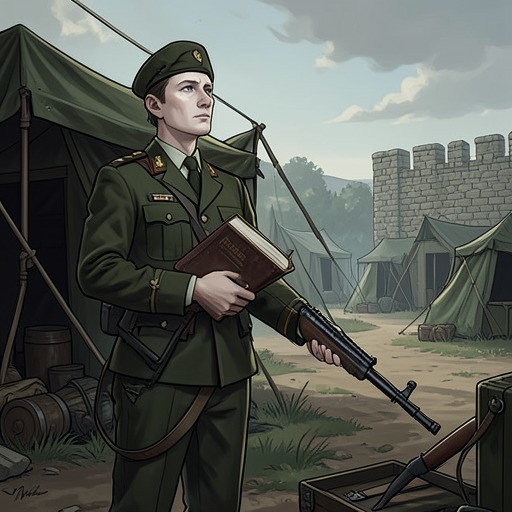
Alfred Minor
The Surgeon of CrowthorneAlfred Minor was the brother, financial representative, and eventual escort of William Chester Minor, whose long confinement at Broadmoor was punctuated by his work on the Oxford English Dictionary. Living in Connecticut, Alfred sustained William’s life in England through regular remittances; decades later, he travelled to London and accepted formal custody of him for the voyage back to the United States. His importance lies in these practical acts of care, which connected William’s solitary institutional life to family support and made his release possible.
Family and Financial Responsibility
The state had designated William an incapable person, and Alfred acted for him in financial matters. William’s pension, about twelve hundred dollars a year, was paid to Alfred in Connecticut. Alfred regularly telegraphed money to England to keep his brother’s account current, giving William the means to furnish his rooms and buy books at Broadmoor. The support was not merely a distant family allowance: it underwrote the comfortable, book-filled life that William constructed within the asylum.
The Proposal to Return to America
After years of confinement, the possibility of sending William back to the United States was raised again. Alfred proposed the plan in a private letter to the Broadmoor superintendent, Dr Brayn, a letter William himself never saw. Dr Brayn indicated that the proposal might be considered if suitable care could be arranged and the American government agreed to the transfer. The plan therefore depended on more than Alfred’s wish to bring his brother home: it required cooperation between the British authorities and the United States government, as well as assurances about William’s safe custody.
Arranging the Transfer
Alfred travelled to London in late March to help resolve the matter. He had spoken with the United States Army in Washington, where officials said William could be transferred to the Government Hospital for the Insane in the American capital if the British Home Office consented. Alfred was also expected to keep his brother in safe custody during the Atlantic crossing. The government review focused on whether William remained dangerous and whether Alfred could be trusted to keep him away from firearms; its recommendation was that William could be released on parole and returned to America.
Taking Custody
At Tilbury Docks, Alfred met William beside the gangway of the SS Minnetonka. The Broadmoor attendant then formally handed William over to him, and Alfred signed a receipt identifying himself as William’s conservator. The document’s administrative language reduced a moment of family reunion to a transfer of responsibility, but the act completed the process Alfred had helped set in motion. The ship left for New York, carrying William away from the institution where he had spent decades and back toward his native country.
Narrative Significance
Alfred’s contribution is presented through a small number of consequential actions rather than an extended account of his own life: he managed the pension, proposed a return, consulted American officials, travelled to London, and accepted custody at the dock. Together, these acts show the family and institutional arrangements behind William’s release. Alfred could not determine the outcome alone, which depended on official consent and a judgment about risk, but he supplied the practical assurance on which the transfer rested.